Cocktail acids: how to make a drink sour without citrus
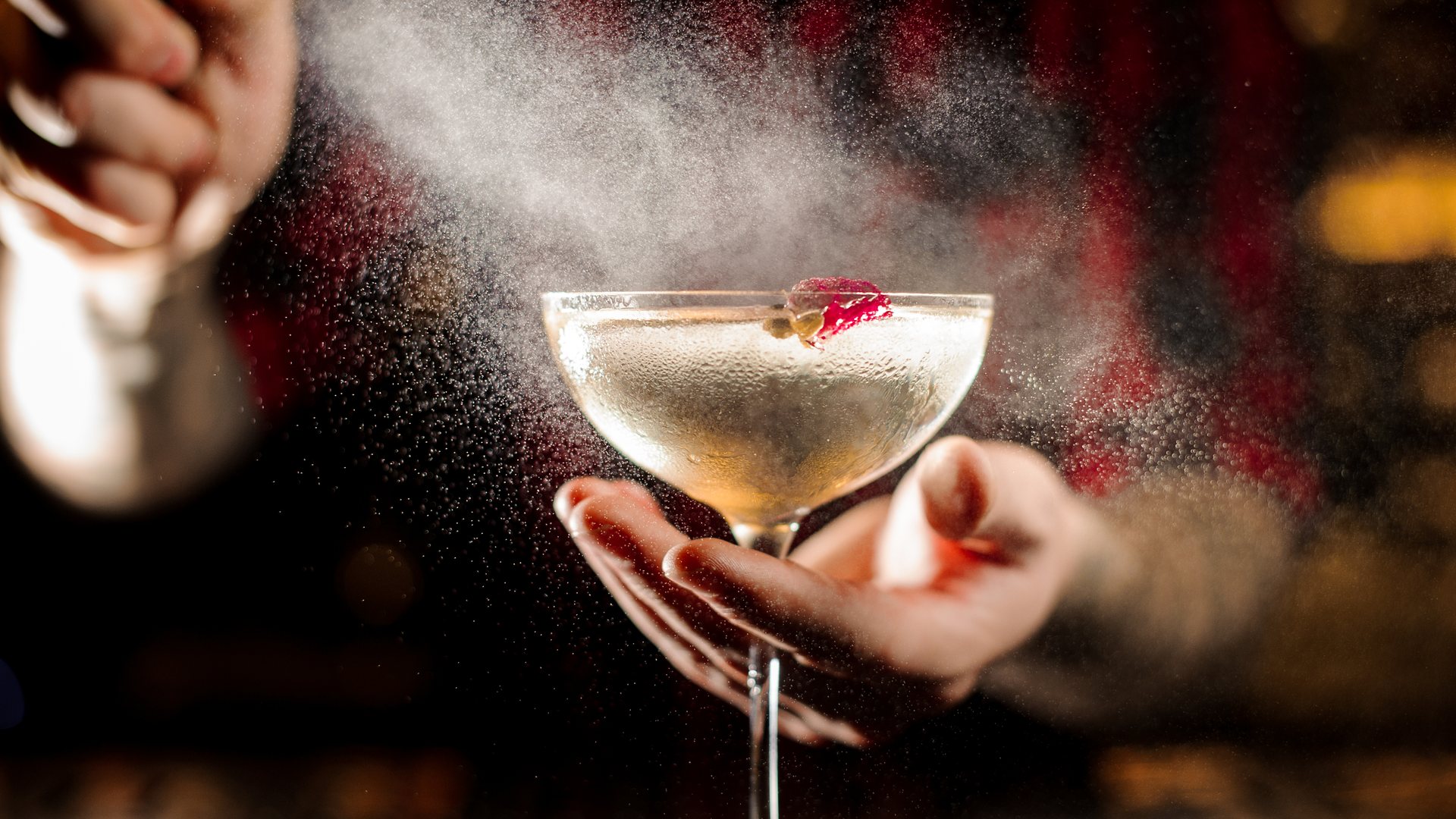
You have probably seen this without getting an explanation for it. A bartender finishes a drink and then, right at the end, reaches for a small bottle. Sometimes it is a dropper and three drops of something clear go in. Sometimes it is a spray, and a cloud of something settles across the surface. No announcement, no label you can read from your seat. The drink goes down in front of you finished.
There is a good chance that bottle held salt water. There is an equally good chance it held acid, or absinthe. None of those answers is as strange as it sounds, and all of them come from one idea, which is worth understanding even if you never buy a gram of powder.
Sour is a sensation, citrus is a flavor
A lime does two separate jobs in a drink, and it does them at the same time, which is why almost nobody notices they are two things.
It makes the drink sour. That is acid, and it is a sensation rather than a taste, closer to how chili is a sensation. It hits the sides of your tongue, makes you salivate, and cuts through sugar and fat.
It makes the drink taste of lime. That is aroma, and it lives mostly in the oil in the peel rather than in the juice.
Because those two things always arrive in the same fruit, we treat them as one ingredient. Every technique below starts by pulling them apart. Once they are separate you can add sourness to a drink that has no business tasting of lime, or add lime aroma to a drink that is already sour enough, and you can do each without dragging the other along.
That is the whole concept. The rest is ratios.
The four acids, and what each one tastes like
They are sold as food-grade powder, they cost very little, and a bag lasts years. You are already eating all of them.
- Citric. The lemon and lime acid. Sharp, immediate, clean, and the one that reads most obviously as "sour." If you buy one, buy this.
- Malic. The apple acid, also found in stone fruit and grapes. Softer on the attack but it lingers longer, with a green-apple tartness. Rounder than citric and slightly less shrill.
- Tartaric. The grape acid. Drying and a little grippy, the sensation you get from a young red wine. Useful in anything wine-adjacent.
- Lactic. The fermentation acid, the one that makes yogurt tangy. Mild, and it reads as creamy and full rather than sharp. It adds body more than bite.
Lactic is the odd one out in handling: it usually arrives as a liquid at around 70% strength rather than as a powder, so it goes into a solution at a different rate.
Buy food-grade. Citric acid is also sold as a descaler and a cleaning agent, in bigger bags at better prices, and that is not the one you want in a drink.
Make a solution, never dose the powder
This is the step people skip, and skipping it is why their first attempt tastes like a battery.
A quarter gram of citric acid is a meaningful amount in a cocktail, and you cannot eyeball a quarter gram, or get it to dissolve evenly in a cold drink. So you dissolve it in water first, once, and then measure the water.
The working solution is 10% by weight: 10g of acid to 100g of water. Stir until it goes clear, funnel it into a bottle, label it, and keep it in the fridge. It lasts for months. For lactic, which is already a 70% liquid, use 5g to 100g of water instead.
A 10% solution lands in the same neighborhood as the acidity of lemon or lime juice, so as a starting point you can swap it in at roughly the same volume the recipe asked for. Taste and adjust from there, because "the same neighborhood" is not the same house.
Blends are where it gets interesting. Lemon juice is very nearly all citric acid. Lime juice is citric with a real amount of malic behind it, which is exactly why lime tastes rounder and slightly more bitter than lemon. So a citric-only solution reads as lemon, and a solution of roughly two parts citric to one part malic reads much closer to lime. That single fact explains most of what the next section is doing.
Saline is the one that surprises people
Not an acid at all, and the most immediately convincing thing in this article.
Make it at 20% by weight: one part salt to four parts water. Use one to three drops per drink, from a dropper.
At that dose it does not make the drink taste salty. What it does is suppress your perception of bitterness, and because bitterness was masking things, everything else gets louder. Sweetness reads sweeter, fruit reads fruitier, and a drink that seemed a bit flat suddenly has edges.
It earns its place fastest in anything with grapefruit, anything built on an amaro, and in low-alcohol drinks, which often taste thin for exactly this reason. A salt rim on a margarita is the same trick performed clumsily, one mouthful at a time.
Try this before you buy any acid at all. Make two of the same drink, put two drops in one of them, and taste them side by side. It costs nothing and it is the fastest way to believe that any of this works.
Super juice, or one lime into a liter
This is the technique with a name, and the one most likely to have sent you here.
It solves two real problems. Fresh citrus juice starts falling apart within hours of being squeezed, so a bottle you juiced this morning is a different ingredient by tonight. And a lime gives you about an ounce, which means a party costs you a bag of fruit and a sore hand.
The insight is the one from the top of this article. The peel holds the aroma, and powdered acid supplies the sour, so if you keep the peel and rebuild the acidity yourself, you can stretch a very small amount of fruit a very long way.
The formula: 100g of peel, 45g citric acid, 8g malic acid, 1 liter of water. Peel the fruit with a vegetable peeler until you have 100g of strips. Put the peels in a container with the acid powders and shake so they are coated. Add the water and stir until the acid dissolves. Blend briefly with an immersion blender, enough to break the peels up but well short of a puree. Strain through a fine mesh.
That yields about a liter, keeps for weeks refrigerated rather than hours, and you still have the naked fruit sitting there to squeeze and stir back in if you want the volume.
Two honest caveats. Formulas vary a lot, and a widely circulated version calls for total acid equal to the weight of the peel, split two to one citric to malic, which is nearly double what is written above. Start light. You can add acid to a finished batch and you cannot take it out. And this is a lime and lemon technique: for lemon, drop the malic and go citric-only, since lemon juice barely contains any malic in the first place.
Acidity with no citrus in the building
Sometimes the problem is not yield or shelf life. Sometimes you want a drink to be bright without tasting of citrus at all, which powdered acid solves and a lemon cannot.
- Verjus. The pressed juice of unripe grapes, sold in bottles. Around a third the acidity of lemon juice, so you use noticeably more of it, and it brings a green, grapey, slightly stony flavor of its own. It is the natural choice in anything wine-based, and in anything you want to keep pale.
- Acid phosphate. A soda-fountain ingredient from the 1800s that never entirely disappeared. Sour and faintly mineral with almost no flavor, which is the point. It is the closest thing to pure sourness you can pour.
- Shrubs and vinegars. Acetic acid instead. Loud, fruity, and a completely different character rather than a substitute. Worth knowing about, not interchangeable with any of the above.
These come into their own in stirred drinks you want to brighten without turning into a sour, and in anything clarified, where adding cloudy juice would undo the work.
The atomizer, or aroma with no volume at all
Everything above has been about separating sourness from citrus flavor. Follow that split to its end and you arrive at the other extreme: putting aroma into a drink without putting any liquid in it.
That is what the small spray bottle behind the bar is for. A fine-mist atomizer costs a few dollars, and it changes what you are able to add to a drink that is already finished and correctly balanced.
The reason it works is that most of what you call taste is smell. A mist sitting on the surface of the glass reaches your nose on the way to the first sip, at full strength, before it has mixed into anything. A quarter teaspoon stirred into the drink would be diluted through the whole thing and half of it would never reach you at all.
What people put in them:
- Absinthe. The classic use, and the one that pays for the bottle. A Sazerac traditionally calls for rinsing the glass with absinthe and discarding the excess, which throws away most of what you poured. Two sprays do the same job with a fraction of the absinthe and far better control over how much lands.
- Peated whisky. Sprayed over a finished stirred drink it gives you smoke on the nose without putting peat into the body of the drink, which is usually where peat goes wrong.
- Bitters. A spray reads as aroma rather than as flavor, which is a genuinely different effect from the same bitters dashed into the tin.
- Rose and orange flower water. These are potent and very easy to overdo. One pull onto the surface is much easier to judge than a dash into the shaker, where it disappears until suddenly the drink tastes like soap.
- Citrus oil. Worth knowing you can, though expressing a fresh peel over the glass does the same thing for free and smells better.
Spray from a distance so it falls as a cloud rather than a jet, and stop at one or two pulls. Held too close it lands as a puddle on the surface instead of a film, and you will taste it rather than smell it. Keep anything sugary out of an atomizer entirely, since syrup clogs the mechanism and it never sprays properly again.
This is the cleanest version of the whole idea. You are adding a top note to a drink whose balance is already settled, without touching the balance at all.
When to skip all of this
Fresh citrus still wins whenever the citrus is the point.
Make a gimlet or a margarita with acid solution and no peel oil and it tastes hollow. Technically sour, correctly balanced, and missing the thing you wanted. You kept the bite and threw away the aroma, and in those drinks the aroma is the drink.
The rule that holds up: if the drink is named after its citrus, squeeze the fruit. Everywhere else, these are fair game, and the case for them gets stronger the further you go from a single fresh drink made to order. They win on batching, on shelf life, on cost at volume, on consistency, and on every drink that needs acid without tasting of fruit.
Which makes this the natural companion to batching for a party. A batched daiquiri made with fresh lime is on a clock from the moment you mix it. The same batch made with acid-adjusted juice is not, and that difference is the reason most bars that batch anything at all end up here eventually.
Where this fits in a build
Drinks get built in five layers: base, balance, character, lengthener, garnish. Acid is a balance ingredient, sitting opposite the sweetener.
Everything in this article is a balance-layer tool. It lets you move the sourness of a drink up or down without touching a single other thing, which is a cleaner adjustment than the usual one of adding more lime and quietly changing the flavor at the same time.
Saline is the exception, because it is not a layer at all. It is a volume knob on everything else in the glass.
FAQ
Is citric acid safe to put in a drink?
Yes, at food-grade. It occurs naturally in all citrus and is added to soft drinks, candy and canned goods routinely. The one thing to get right is buying the food-grade product rather than the descaling or cleaning version, which is the same compound at a different purity and is not sold for eating.
Can I substitute acid solution one-for-one for lemon juice?
As a starting point, close. A 10% solution sits near the acidity of citrus juice, so the same volume gets you in range. What you will not get is aroma, so the drink can taste correct and empty at the same time. Add a strip of peel, or stir a small amount of real juice back in.
What is the difference between citric and malic acid?
Citric is sharp and immediate and reads as lemon or lime. Malic is softer at first but lasts longer on the palate, with a green-apple quality. Lemon juice is nearly all citric; lime juice is citric with malic behind it, which is why a two-to-one citric and malic blend reads more like lime than citric alone.
How long does super juice keep?
Weeks in the refrigerator, against hours for fresh-squeezed. Shelf life is one of the two problems the technique exists to solve, the other being yield.
Does saline solution make a cocktail taste salty?
Not at one to three drops of a 20% solution. Below the level where you taste salt, it suppresses bitterness, and everything the bitterness was covering gets louder. If a drink does taste salty, you used too much, which is easy to do and easy to fix next time.
What are bartenders spraying on top of a drink?
Most often absinthe, which coats the glass with a fraction of what a traditional rinse would use. After that, peated whisky for smoke, bitters, or a floral water like rose or orange flower. The point of spraying rather than pouring is that the aroma sits on the surface and reaches your nose at full strength, without adding volume or changing the balance of a drink that is already finished.
Do I need a scale?
Yes, and it is the only equipment this requires. These are all weight ratios and the quantities are small enough that volume measures will not do. An inexpensive scale that reads to a tenth of a gram covers everything here.
Where do you buy the powders?
Homebrew and winemaking suppliers, the canning section of a large grocery, or online. They are cheap, they arrive in quantities far larger than you will use, and they keep more or less indefinitely if you keep them dry.
Is any of this cheating?
No more than using a jigger. It is the same drink, balanced on purpose instead of by luck, and it makes a party possible that a bag of limes does not.
MixKings gives syrups, acids and bitters a shelf of their own, so the bottle you mixed in March is still labelled and findable when you need it.