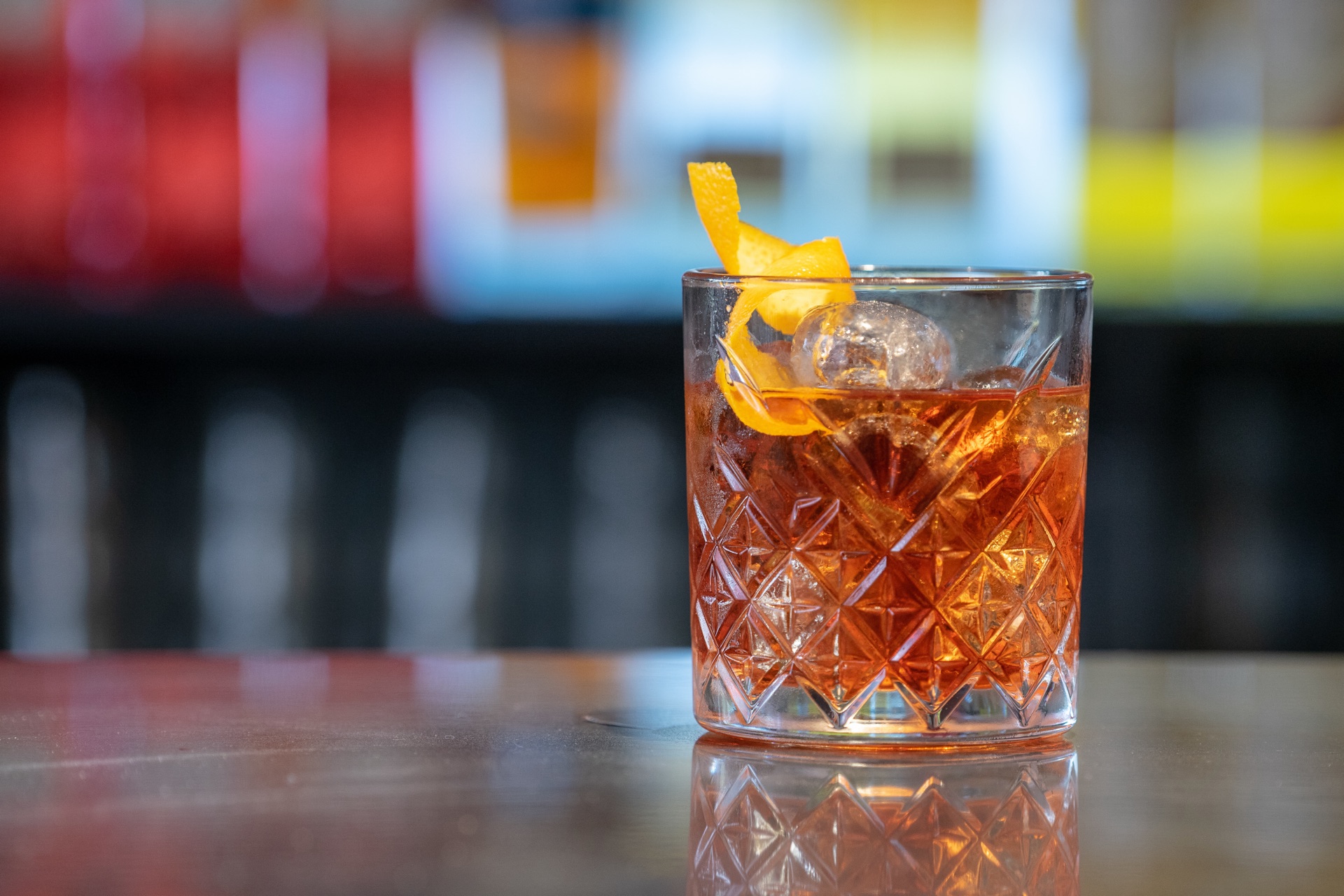
Spirit-forward cocktails: the three shapes behind every stirred classic
Spirit-forward drinks are the shortest pour in the whole canon, around 3½ oz in the glass, and the least forgiving. There is no citrus to hide behind and no soda to stretch things out. What you put in is what you taste.
People assume that makes them advanced. It is closer to the opposite: the recipes are the simplest anywhere, often three ingredients, and the difficulty lives almost entirely in technique. Two people can build the same Manhattan from the same bottles and produce noticeably different drinks.
Here are the three templates that cover nearly all of them, the technique that decides how they turn out, and the one storage mistake that quietly ruins more of these drinks than anything else.
The defining rule: no citrus, so stir
The line between this family and sours is simple. Sours contain citrus, so they get shaken. Spirit-forward drinks contain none, so they get stirred.
That is not fussiness. Shaking aerates and clouds a drink, which is exactly right when you have citrus, sugar, or egg to integrate, and exactly wrong when you have three spirits that are already miscible. Shake a Martini and you get a cloudy, slightly foamy drink with ice shards in it. Stir it and you get something clear, dense, and cold.
The other reason is dilution. A sour wants about a quarter of its volume in melted ice. A spirit-forward drink wants less, and stirring gives you fine control that shaking does not. Roughly 20 to 25 percent dilution is the target, which is about 30 seconds of stirring with good ice.
Shape one: spirit, sugar, bitters
2 oz spirit · ¼ oz sweetener · 2 dashes bitters. The oldest cocktail formula there is, and for a century the word "cocktail" meant precisely this.
The Old Fashioned is the whole shape: bourbon or rye, a little sugar, Angostura, orange twist. Swap in rye and absinthe and you have a Sazerac. Swap in rum and you have an Old Cuban ancestor; swap in tequila and it still works.
What to know: the sweetener is doing less than you think. Its job is to soften the spirit's edges, not to make the drink sweet. Start at a quarter ounce and go down before you go up.
Shape two: spirit and fortified wine
2½ oz spirit · 1 oz vermouth · dash of bitters. The 2:1 family, and the largest of the three.
Manhattan is rye and sweet vermouth. Martini is gin and dry vermouth. Rob Roy is scotch and sweet vermouth. Vieux Carré stacks rye and cognac against sweet vermouth and Bénédictine. Change the base or change the vermouth and the drink gets a new name.
What to know: this is where vermouth quality shows most, and where the mistake in the next section does the most damage. It is also the shape with the widest legitimate range. A 2:1 Martini and a 5:1 Martini are both correct; they are just different drinks.
Shape three: equal parts
1 oz · 1 oz · 1 oz. The easiest cocktail formula in existence to remember, and the hardest to improve on.
Negroni is gin, Campari, sweet vermouth. Swap gin for bourbon and it is a Boulevardier. Swap for mezcal and you have a smoky one. Swap Campari for a gentler amaro and it becomes approachable for people who find Negronis punishing.
What to know: equal parts only works when all three components are assertive enough to hold their ground. It is a template for bitter liqueurs and fortified wines, not for a delicate base.
The vermouth mistake
If you take one thing from this article, take this: vermouth is wine, and it goes bad.
Most people keep it in a cupboard next to the gin for months, which is exactly how you would ruin any bottle of wine. Oxidized vermouth tastes flat, sour, and vaguely stale, and it will drag down every Manhattan and Martini you make with it while you quietly conclude that you do not like Manhattans.
Refrigerate it after opening. Use it within a month or so. Buy small bottles rather than large ones, since you will use it an ounce at a time. A fresh bottle of ordinary vermouth beats an old bottle of excellent vermouth every time.
This is the exact counterpart to fresh citrus in sours. One ingredient, badly stored, silently caps how good anything in the family can be.
The rest of the technique
Stir about 30 seconds. Long enough to chill and dilute properly. Under-stirred spirit-forward drinks taste hot and disjointed, which people misread as the drink being too strong.
Use good ice. Big, dry, solid cubes in the mixing glass, and ideally one large cube in the serving glass if it is served over ice. Small wet ice dilutes fast and unevenly, and you lose the control that made stirring worth doing.
Chill the glass. More important here than anywhere else, because these drinks are served small and without ice, so they warm quickly. A room-temperature coupe undoes 30 seconds of careful stirring in about two minutes.
Express the twist. Squeeze the citrus peel over the surface so the oils land on the drink. That aroma is a real part of the recipe, not decoration, and it is the difference between a Martini that smells like something and one that smells like cold alcohol.
Buy a better base. This is the one family where the bottle genuinely matters. There is nothing to hide behind, so a harsh spirit stays harsh. It does not need to be expensive, but it needs to be something you would drink on its own.
How to build your own
The reliable move in this family is the split base. Instead of 2½ oz of one spirit, use 1½ oz of one and 1 oz of another. Rye and cognac. Bourbon and aged rum. Gin and mezcal. You keep the ratio and the structure, and you get complexity that no single bottle offers.
After that, change the modifier. Sweet vermouth to a nutty amaro, or to sherry, or to a split of vermouth and a bitter liqueur. The bitters slot is the smallest lever but the fastest to test, since a different dash changes the aroma before the first sip.
What not to do: add citrus. The moment you do, you have left this family and built a sour, and it will need shaking and a different ratio to work.
FAQ
What is a spirit-forward cocktail?
A cocktail made mostly of spirits, with no citrus, stirred rather than shaken, and served small. Old Fashioneds, Manhattans, Martinis, and Negronis are the canonical examples. They typically run about 3½ oz in the glass.
Why are some cocktails stirred instead of shaken?
Shaking aerates and clouds a drink and chills it fast, which suits citrus, sugar, and egg. Drinks made entirely of spirits need neither the aeration nor the hard chill, and stirring gives finer control over dilution while keeping the drink clear.
How long should you stir a cocktail?
About 30 seconds with plenty of solid ice, aiming for roughly 20 to 25 percent dilution. Under-stirring is far more common than over-stirring, and it makes a drink taste harsh rather than strong.
Does vermouth need to be refrigerated?
Yes. Vermouth is fortified wine and oxidizes once opened. Keep it in the fridge and use it within about a month. Old vermouth is the most common reason a home Manhattan tastes flat.
What is the difference between a Manhattan and a Negroni?
Both are stirred and spirit-forward, but a Manhattan is roughly 2 parts whiskey to 1 part sweet vermouth with bitters, while a Negroni is equal parts gin, Campari, and sweet vermouth. The Negroni is bitterer and the Manhattan is stronger and rounder.
MixKings keeps your builds filed by family, so the split-base Manhattan you nailed once is still there next time.