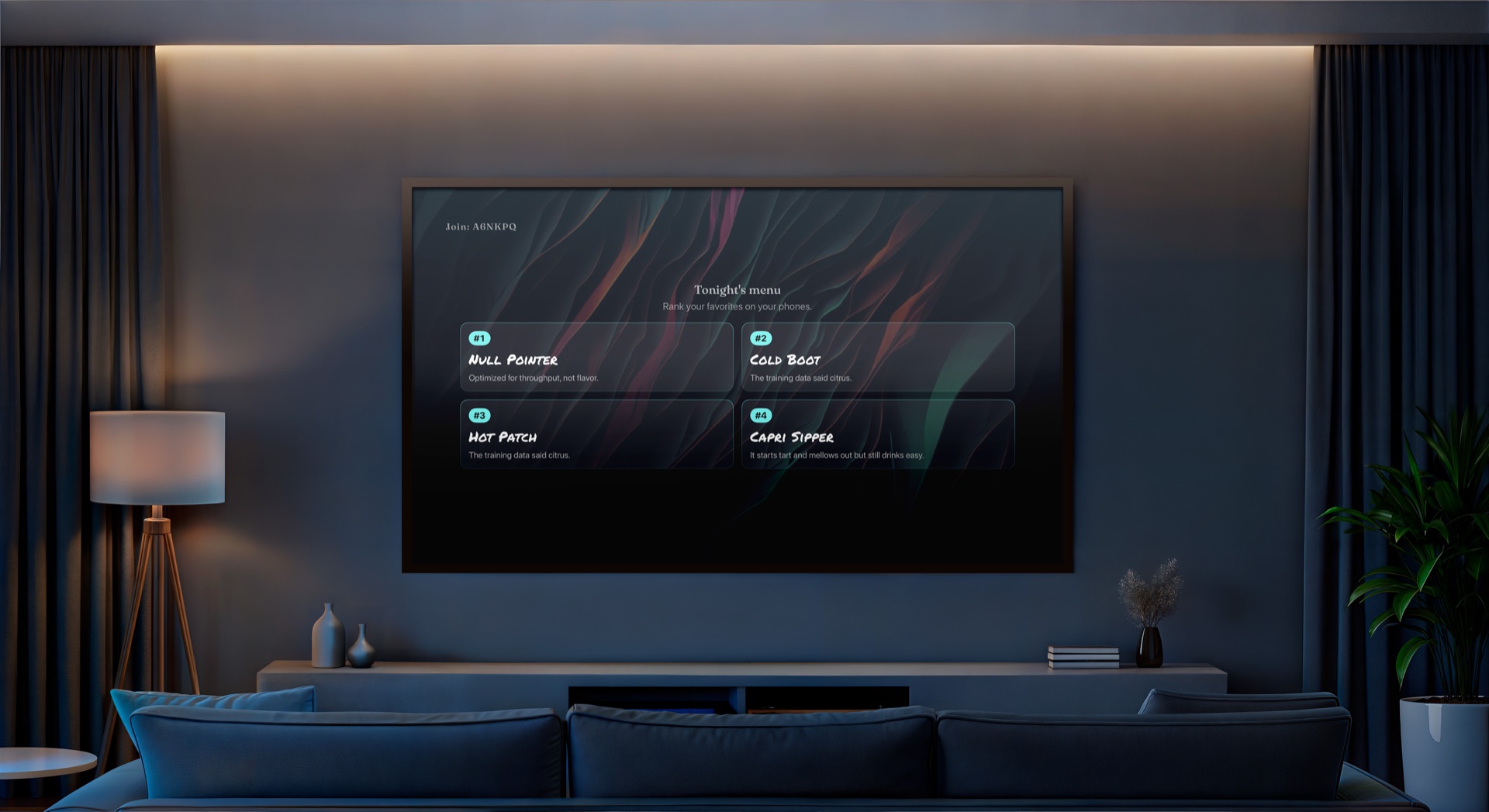
Hosting a cocktail competition. Judges are optional.
Most guides around hosting a cocktail competition tell you to do the same three things: pick a theme, appoint judges, score on taste and presentation. That structure takes a lot of planning, and it isn't what a casual night with friends needs.
What a judging panel is for
In a real competition, judges solve a specific problem. Strangers are competing for something valuable, so the outcome has to be defensible to people who have no particular reason to trust each other. Expertise supplies authority, and authority makes the result stick.
At your place nobody is a stranger, and nothing is at stake aside from a good time and maybe some bragging rights. The problem that judges exist to solve is not in the room.
What is in the room is a group of friends, and a panel does two things to a group of friends. It demands expertise nobody has. In the rare case somebody genuinely has it, they are the worst possible choice for the bench, because they are the person everyone most wants in the game. And it stops the night. Somebody has to deliberate while everyone else stands around holding an empty glass, waiting to be told what they already tasted ten minutes ago.
Let the room decide
The fix is not a better panel. It is no panel. Everyone tastes, and everyone picks.
Everybody gets to play, and nothing stops, because the choosing happens while people are drinking rather than after.
With MixKings the focus is time spent with friends over a few good cocktails. Everyone can play the judge anonymously if that's the night you want. Or you can use one of the play styles to answer the question that always arrives on its own: what are we drinking next?
First, what everyone is building
Before a round starts you pick a mode: riff, freestyle, or theme.
- Riff. You choose a base drink and everyone changes it.
- Freestyle. Wide open, from a blank slate or from your own library, with a prompt if you'd rather be given one.
- Theme. Pick a category and everyone builds inside it.
Then, how the competition runs
Four play styles, and they run from most competitive to least. Pick by how much of a contest you want the evening to be.
Taste-off
The closest thing here to a real cocktail contest, and the one to choose if you want it to feel like one.
Every drink gets made. The room tastes them without knowing who built what, and the host doing the pouring doesn't know either, so the blindness is real rather than a courtesy. Then everyone ranks the field from favorite to least.
That anonymity is the thing a panel can't give you. Nobody is weighing up a friend's drink in front of them. They're ranking a glass, not a person.
One practical note, since this is the style that needs the most setup. Everyone tastes everything, so the glasses multiply: six people is thirty-six pours, not six. Labeling that many by hand is where an evening stalls.
Decide how you're marking them before you pour. MixKings labels the wall with numbers, with colored dots, or not at all, so you can match whatever is already in the drawer. Colored dots are the fast path once the count climbs, since there's nothing to write, and "the blue one" carries across a table better than "number four". The palette runs to seven; a bigger field goes back to numbers.
Drink the winner
The quickest, and the right default for a first game.
Everyone builds a drink, names it, and writes a line about it. You get a sense of how yours is landing against the room as you go. Then everyone votes for what they'd most like to try, the way you'd order from a menu, and the winner gets made.
Worth knowing that this is a vote on the idea rather than the taste, because nothing has been poured yet. That's exactly why it's fast.
Build a menu
No vote, no winner. Every drink lands on a menu and gets made, and the room works through them however it likes.
This is the one for a longer evening, and the one where nobody loses. If your group has someone who'd rather not be scored at all, this is the style to open with.
Rounds
A combination of the two above. You play drink-the-winner rounds one after another, and each round's winner collects onto a menu at the end.
It's the structured version of a night, and it scales the evening up without letting any single round drag.
Picking one
If you want the contest feeling, run a taste-off and accept that every drink has to be built before anyone votes. If you want to be drinking within twenty minutes, drink the winner. If you'd rather nobody lost, build a menu. If you have a whole evening, play rounds.
None of them need a bench, and none of them need anyone to sit out. For the full walkthrough of a game night, from building your shelf through the reveal on the TV, see how to play MixKings. If you'd rather run the whole thing off-app with paper and a timer, the hosting guide has formats, group sizes and rules you can copy.
FAQ
Do you need judges for a cocktail competition at home?
No. Judges exist to make a result defensible between strangers with something at stake, and neither applies at a house party. Having everyone taste and pick is faster, and it keeps the person who knows the most about cocktails in the game instead of on a bench.
How do you keep it fair without a panel?
Make it blind. In a taste-off nobody knows who built what, including the host pouring the drinks, so people rank what's in the glass rather than whose it is.
What do you need to run a blind tasting at home?
Small tasting glasses and something to mark them with. The count climbs faster than people expect, because everyone tastes everything: six players is thirty-six glasses. Colored dot stickers beat numbered ones at that scale, since there's nothing to write on them. Keep the pours small so everyone can try the whole field and still enjoy the rest of the night.
Which style should a first-time group pick?
Drink the winner. Everyone builds, everyone votes on the idea, one drink gets made. It's the fastest way to see how a round feels before committing an evening to it.
MixKings runs the voting from everyone's phone and puts the result on the TV, so nobody is tallying anything on a napkin.