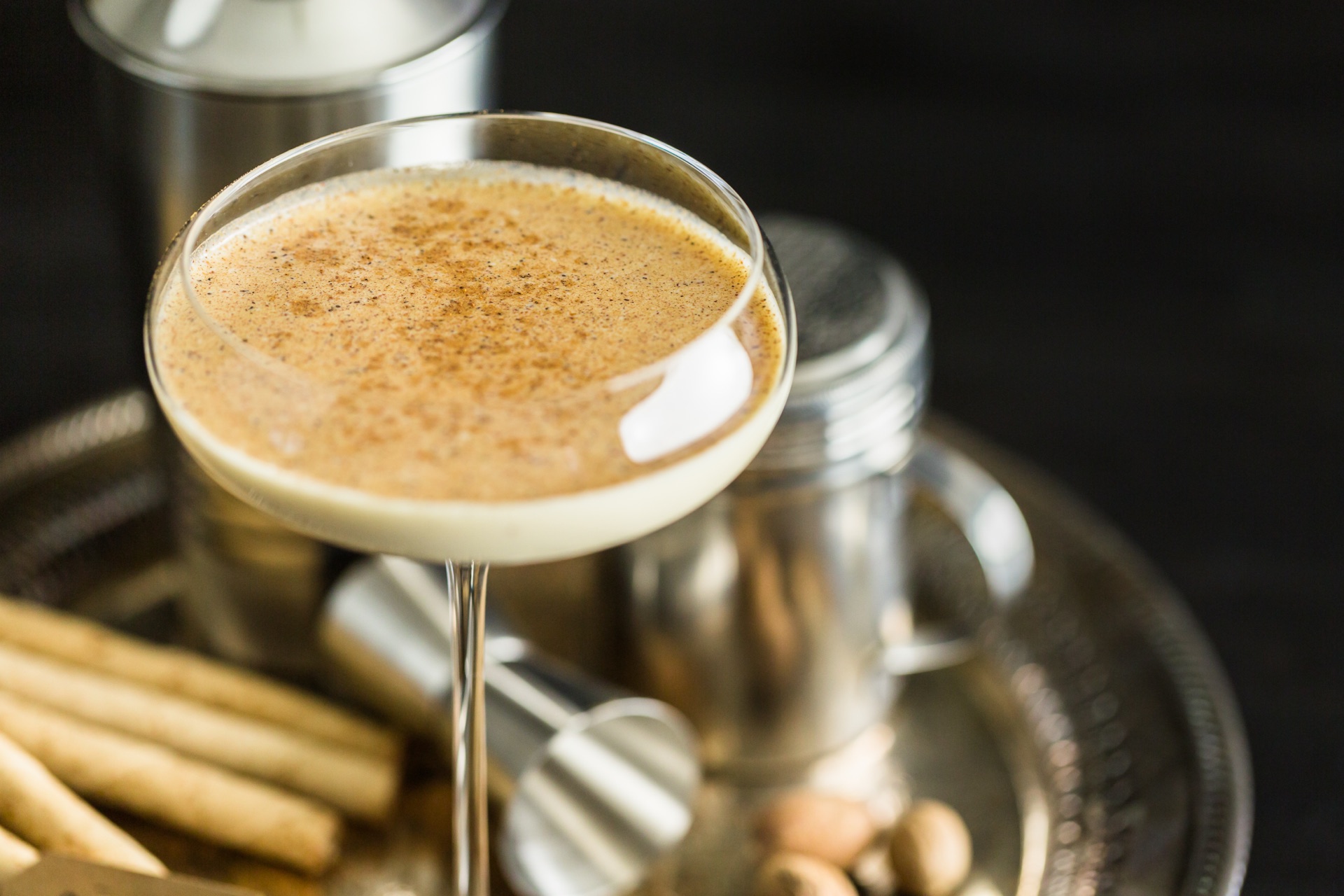
Flips and nogs: why the yolk is the whole point
This is the family people skip. Raw egg in a drink sounds like a dare rather than dessert, and the one member most people have met is a carton of eggnog that tasted like sweetened wallpaper paste.
Which is a shame, because the mechanism is simple and the payoff is a texture you cannot get any other way. No amount of cream, syrup, or shaking will give you what a yolk gives you.
It is also the family people are already drinking without noticing. If you have ordered a Whiskey Sour with that thick white cap on it, you have had egg in a cocktail. The difference between that drink and this family comes down to which part of the egg went in, and that single distinction is the entire category.
Egg white foams, egg yolk thickens
They are two different ingredients that happen to arrive in the same shell.
The white is mostly protein and water. Agitate it and it whips into foam, which floats to the top and sits there. It contributes almost no flavor and no richness. What it gives you is a surface: a dense white cap that holds aroma and softens the first sip.
The yolk is fat and lecithin, which is an emulsifier. It does not float or foam. It disperses through the entire drink and thickens it from within, turning a thin liquid into something closer to a thin custard. It also carries flavor, adding a faint richness that reads almost like vanilla against a dark spirit.
So: the white is something you put on a drink. The yolk is something you put in one.
This is worth being precise about, because it draws a boundary people argue over. A Whiskey Sour, a Clover Club, a Pink Lady, and a Ramos Gin Fizz all contain egg white, and all four are sours, not flips. The white sits on top of a sour and leaves the drink underneath unchanged. Take it away and you still have the same cocktail, just barer.
A flip uses the whole egg, or sometimes the yolk alone. Take that away and there is no drink left, only sweetened spirit. That is the test: if removing the egg leaves a working cocktail, it was a sour with a hat on. If removing it leaves a puddle, it was a flip.
The template
1½ to 2 oz spirit or fortified wine · 1 whole egg · ½ to ¾ oz sugar · grated nutmeg. Around 4 oz in a small coupe once shaken.
Two things stand out. There is no citrus anywhere, which makes this the only family besides spirit-forward drinks with no acid in the template. And the sweetener is doing a different job than usual, balancing richness rather than balancing sourness.
That absence of acid is why flips read as after-dinner drinks. Nothing in them cuts or refreshes. They are meant to sit at the end of a meal where a dessert would otherwise go.
The canon, all on that shape:
- Porto Flip. Tawny port, a little brandy, whole egg, sugar, nutmeg. The archetype, and the one to make first. Port's dried-fruit sweetness is exactly what the yolk wants.
- Brandy Flip. The same idea with brandy alone. Simpler, warmer, and a good test of your sugar level, since there is nowhere to hide.
- Sherry Flip. Oloroso or amontillado, whole egg, sugar. Lighter than it sounds and the best entry point if the idea of a rich drink puts you off.
- Coffee Cocktail. Port, cognac, whole egg, sugar. It contains no coffee at all. It was named in the 1880s for its color, which tells you how it looks in the glass.
- Boston Flip. Rye and madeira together, whole egg, sugar. The most cocktail-like of the group, and the one that most rewards a good rye.
- Eggnog. Brandy, rum, or bourbon, whole egg, sugar, milk and cream, nutmeg. A flip with dairy added.
- Tom & Jerry. A hot one. Whites and yolks beaten separately into a sweet batter, spooned into a mug with rum and brandy, topped with hot milk. Labor-intensive and worth it once a winter.
The word flip originally meant something else entirely: a hot beer and rum drink that got its name from a red-hot iron plunged into the tankard to make it froth. The egg arrived later, the beer left, and the name stayed.
The dry shake earns its keep here
Shake the drink once without ice, then again with it.
The first shake, with no ice in the tin, is where emulsification happens. Nothing is being chilled and nothing is being diluted; you are working the egg into the liquid so it becomes one texture instead of two. The second shake, with ice, does the chilling and dilution as normal.
This technique matters more with a yolk than with a white. Whipping a white into foam is easy and happens almost by accident. Emulsifying fat into alcohol takes real agitation, and a flip that was shaken only once tends to arrive thin, with a slick on top. Give the first shake a hard fifteen seconds.
Some bartenders reverse the order, shaking with ice first, straining the ice out, then shaking again without it. That produces a denser texture and is worth trying once you have the standard version working.
Strain into a small chilled coupe and grate nutmeg over the top. Not pre-ground, which tastes of dust. A whole nutmeg keeps for years and costs less than a cocktail.
Nogs are flips with dairy
Add milk, cream, or both to a flip and you have a nog. That is the whole difference.
The dairy dilutes the intensity and stretches the volume, which is why nog is the version that scales to a crowd while a flip stays a single serving. It also makes the drink more forgiving. A flip with too much sugar is cloying; a nog with too much sugar is just a nog.
Nog is also the rare cocktail that improves with batching, and the only one that genuinely improves with age. A batch made with enough spirit and left refrigerated for a few weeks comes out smoother and rounder than it went in, as the alcohol works on the dairy proteins. Traditional recipes call for a month, and some households run a year ahead deliberately.
That aging only works above a certain proof, which is the part recipes tend to gloss over. The alcohol is doing preservation work as well as flavor work. A low-alcohol nog is a fresh drink, not a keeping one, and should be treated like any other dairy in the fridge.
If you have only met the carton version, the homemade one is a different drink entirely. It is thinner than you expect, boozier, and tastes of nutmeg and spirit rather than sugar.
About the raw egg
Worth addressing directly, since it is the reason most people never try the family.
The risk from a fresh, clean, properly refrigerated egg is low but not zero. If you would like it to be zero, buy in-shell pasteurised eggs, which are heat-treated in the shell and behave identically in a drink. They are stocked in most large groceries and are the straightforward answer.
Use pasteurised eggs without thinking about it if you are serving anyone pregnant, elderly, very young, or immunocompromised. That is not a cocktail judgment, it is the same advice that applies to homemade mayonnaise or a soft-set custard.
On substitutes: aquafaba, the liquid from a can of chickpeas, is a genuinely good replacement for egg white and foams nearly as well. There is no equivalent for the yolk. Nothing else brings fat and lecithin in the same package, and drinks built to be thickened by one fall flat without it. Cream gets you a fraction of the way and is a different drink, not a substitute.
How to build your own
Start with a Sherry Flip, because sherry is cheap, keeps in the fridge, and is forgiving of a heavy hand: 2 oz oloroso, 1 whole egg, ½ oz simple syrup. Dry shake hard, shake with ice, strain, nutmeg.
Change the base first. Port, madeira, brandy, aged rum, bourbon. Anything with sweetness and body already in it works; anything sharp and clean fights the yolk. This is not the place for a London dry gin.
Then move the sugar. Flips live or die on sweetness, and the correct level depends entirely on how sweet the base already is. A tawny port needs less than a dry sherry. Adjust in quarter-ounce steps and taste every time.
Then split the base. The same trick that tiki relies on works here. Port with a half ounce of cognac is more interesting than port alone, and rye with madeira is better than either by itself.
Then add dairy if you want a nog. Two ounces of whole milk turns any of the above into a nog and roughly doubles the glass.
One change per attempt, same as every other family. There are fewer slots here than in tiki, which makes each one easier to hear.
FAQ
What is a flip cocktail?
A drink built on a spirit or fortified wine, a whole egg, and sugar, shaken and served in a small coupe with grated nutmeg. There is no citrus. The whole egg, and specifically the yolk, thickens the drink from within rather than sitting on top as foam.
What is the difference between a flip and a sour with egg white?
Which part of the egg is used, and what it does. Egg white foams and floats, so a Whiskey Sour or Clover Club is a sour with a foam cap. A whole egg emulsifies through the drink and gives it body, which makes it a flip. Remove the egg from a sour and you still have a cocktail; remove it from a flip and you do not.
How do you separate an egg white from the yolk?
Crack the egg in half and pass the yolk back and forth between the two shell halves, letting the white run out underneath. Most flips use the whole egg so you can skip this entirely, but you will need it for a Tom & Jerry, for yolk-only versions, and any time you are making a sour.
Do it over a separate glass rather than straight into the drink, particularly the first few times. If the yolk breaks or the egg turns out to be off, you have lost one egg instead of the whole cocktail. Tip the white in once you are happy with it.
If the shell edge keeps piercing the yolk, use your hand instead: crack into a clean cupped palm and let the white run between your fingers. It is gentler than a shell and much harder to get wrong.
Is raw egg in cocktails safe?
The risk from a fresh, clean, refrigerated egg is low but not zero. In-shell pasteurised eggs remove it entirely and work exactly the same in a drink. Use pasteurised when serving anyone pregnant, elderly, very young, or immunocompromised.
What is the difference between eggnog and a flip?
Dairy. A nog is a flip with milk or cream added, which softens the intensity and increases the volume. It is also the reason nog batches and ages well while a flip is made one at a time.
Can I use aquafaba instead of egg?
For egg white, yes, and it foams nearly as well. For the yolk, no. Nothing else supplies the fat and lecithin that give a flip its body, so a flip made without a yolk is simply a sweetened spirit.
Is a Brandy Alexander a flip?
No. It is rich and creamy, but it contains cream rather than egg, so nothing is being emulsified. It sits next door to this family without being in it.
MixKings keeps your fortified wines on their own shelf, so the bottle you bought for one flip is still findable in December.