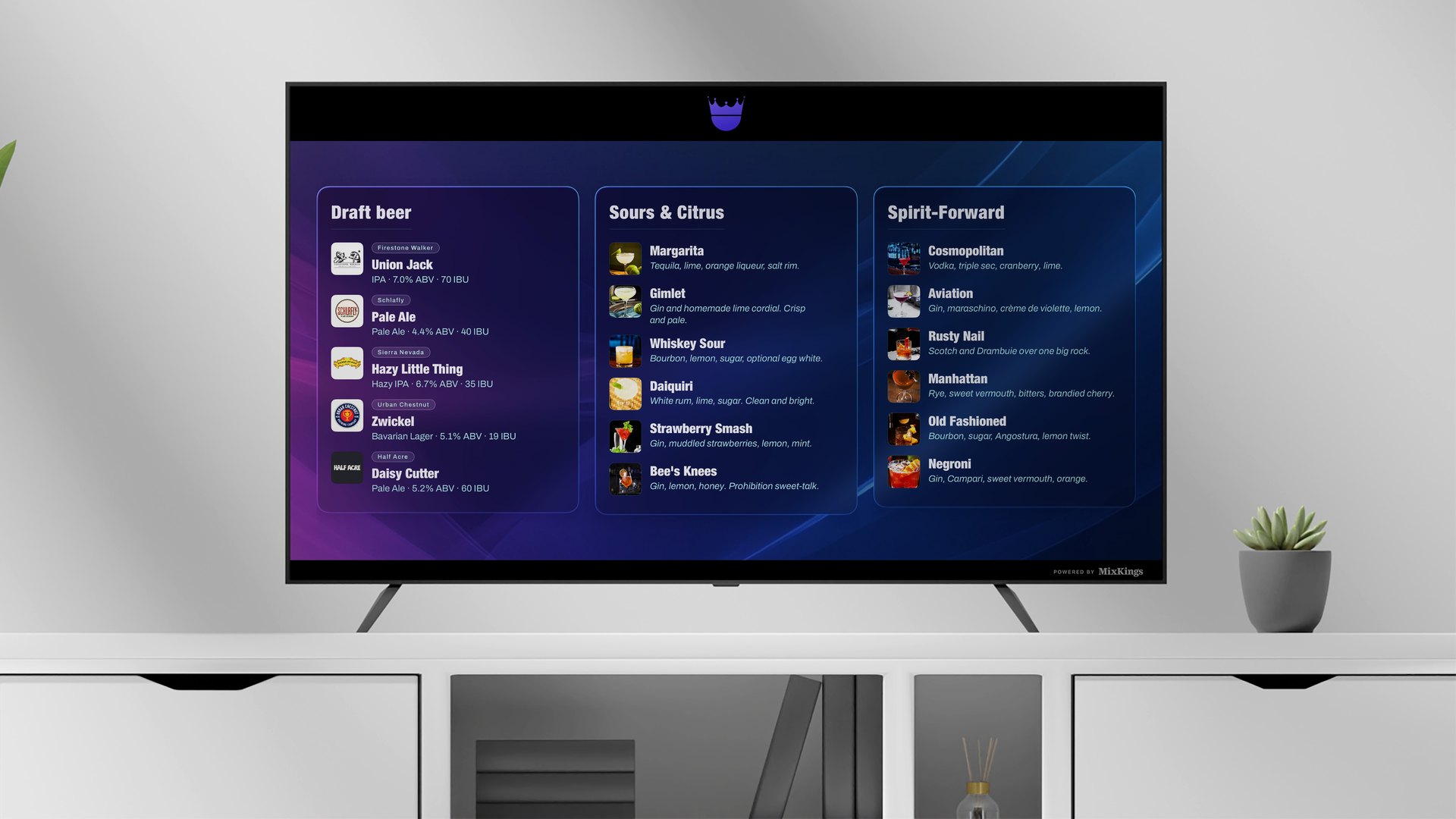
How to make a home bar menu that doesn't go stale
Somebody asks what you have. You start listing bottles. They stop you three in and say gin is fine, whatever's easiest, and you make them a gin and tonic while a shelf of things you were excited about goes unmentioned.
That is the moment a menu fixes, and it is the reason people keep making them by hand in a word processor at eleven at night before a party.
It is also the reason most of those menus get made exactly once. Not because the menu was a bad idea, but because keeping it true costs more than it gives back. Two bottles change and the thing on the counter is now lying to your guests.
So here is how to build one worth the effort, and what to do about the part that always breaks.
What a menu is for
Worth being clear about, because it changes what goes on it.
It gets people to order rather than ask. Asking "what can you make?" puts a guest in the position of requesting something you might not be able to do, which most people would rather avoid. A list removes that. They pick, you pour.
It sets the boundaries of the night. You are pouring from the menu, not from the entire cabinet. That is a kindness to yourself at eleven o'clock when someone wants something with three ingredients you would have to go find.
It gets your good stuff ordered. The bottle you were excited about does not sell itself from inside a cupboard. On a list, next to a name, it does.
Notice that none of those three jobs require the menu to be complete. That matters more than anything else here.
Your library is not your menu
This is the mistake underneath most home bar menus, including the ones people give up on.
Everything you know how to make is one thing. What you are pouring tonight is another. Treating them as a single document is what makes the whole exercise feel like work, because now every small change turns into a full audit of the cabinet.
The usual advice here is to keep the list short, and it is worth asking where that came from, because it was never really about the reader. A page runs out of room. And a host has to remember how to build everything on the list, which quietly caps the menu at whatever you can hold in your head at eleven at night with people talking to you.
Neither of those is a law. A screen does not run out of room, and if you can pull up a build in a couple of seconds, memory stops being the ceiling. Twenty drinks is not unreasonable. Thirty is not unreasonable. What matters is whether the list is honest.
Because the constraint that does survive is your shelf. Every drink on the menu is a promise that you can pour it, so the real limit is what you have the ingredients for tonight. That is a much better question than a number somebody picked, and it is the one that decides whether the night goes smoothly.
Length stops mattering once the grouping is right, which is the next section. Five drinks under a heading read as five drinks, whether there are two headings or five.
Group by style, not alphabetically
People do not order alphabetically. They order by mood, and they arrive at the bar already knowing roughly what they want: something bracing, something long and cold, something that tastes like dessert.
So group the list the way a good bar does. Four headings is plenty:
- Bold and spirit-forward. Stirred, strong, brown. The Negroni and Manhattan end of the shelf.
- Bright and sour. Citrus, shaken, the biggest crowd-pleaser section you have. Most people order from here.
- Tall and refreshing. Highballs and fizzes, which is where you put the things people drink two of.
- No proof. Always. More on this below.
Those headings do a second job beyond navigation: they tell a guest who does not know cocktails what they are choosing between. "Bright and sour" is a promise anyone can evaluate. "Corpse Reviver No. 2" is not.
If you want a more precise vocabulary for grouping, the ten cocktail families are the underlying structure most bar menus are quietly organised by.
Write entries like a bar, not a recipe book
Name, then ingredients, four or five words, no measurements.
Penicillin. Scotch, honey, ginger, lemon.
That is the whole format. Your guest is choosing, not building, and the numbers are your problem rather than theirs. Measurements on a menu make it read like homework and take up the space that would otherwise let the type breathe.
Two things worth adding when they are true. Mark the strong ones, because somebody is on their third and would like to know. And name your own drinks properly. If you invented it, it deserves better than "Whiskey Sour variation," and a real name is the single easiest way to make a home menu feel like a bar menu.
A wrong menu is worse than a short one
The credibility of the list is the whole asset. One entry you can't make costs you more than the entry was worth, because now your guest has ordered, been told no, and has to choose again with less confidence in everything else on the page.
So when the limes run out, deal with it rather than hoping nobody picks that one.
On a board or a printed card, cross it out instead of ignoring it. A struck-through line reads as a menu somebody is keeping current. An unmarked wrong entry reads as one nobody has looked at in a month, and it makes a guest quietly distrust the rest.
On a screen, take it off and put it back when the bottle returns. That is the version that costs you nothing, which is the entire argument for a screen and the subject of the next section.
If somebody isn't drinking, put it on the menu
Four friends over and everyone's drinking? Skip this. It doesn't apply.
But on the night there is somebody who isn't, whether they're driving, pregnant, on antibiotics, sober, or just not tonight, a real option on the list means they order like everyone else. Without one they have to ask whether you have anything without alcohol, and most people would rather not ask, and some would rather not explain. The menu handles both quietly.
Word it like the rest of the list when you do include it. Tucked at the bottom in smaller type reads as an afterthought, which is the exact impression you were trying to avoid.
If you want to do it properly, building drinks that stand on their own without alcohol is its own skill.
The update problem is what kills menus
Every method of making a home bar menu works fine on day one. They differ entirely in what happens on day thirty.
A chalkboard looks the part and is legible for about six drinks. Rewriting it is enough of a chore that it tends to stay wrong.
A printed or framed menu looks the best of any option and is the worst to change. One bottle runs out and you either reprint or serve from a menu that is now inaccurate.
A document you print at home is what most people land on. It works, up to the point where the list grows enough that formatting becomes the task rather than the drinks, and every ingredient change means opening the file, fixing the layout, and finding paper.
None of those are bad at being a menu. They are bad at staying one, and that is why the effort feels wasted. You are not maintaining a list, you are re-making it.
Which is why the version on a screen is a different object rather than the same object with a plug. When the menu is something you edit rather than something you produce, pulling a drink takes a second, adding the thing you made last night takes a minute, and the list on the wall is true tonight instead of true in April.
That is what MixKings does. You build the menu on your phone, and it shows on the biggest screen in the room, styled the way you want and correct as of ten seconds ago. The setup side of that, which TV, how to cast it, where to put the screen, is covered in the guide to setting up a living room bar.
Paper is still lovely for a dinner where the list is fixed and you know it a week out. For a home bar that changes every time you buy a bottle, it is the format fighting you rather than the effort.
FAQ
How many drinks should be on a home bar menu?
As many as you have the ingredients for. The old rule of keeping it to eight or ten came from paper running out of room and hosts having to memorize every build, and neither is a hard limit now. Twenty or thirty is fine if the list is grouped well and you can pour all of it. What matters is that every drink on there is one you can make tonight.
How do you organise a cocktail menu?
By style rather than alphabetically, because people order by mood. Four headings covers it: bold and spirit-forward, bright and sour, tall and refreshing, and no proof. The headings also let someone who does not know cocktails understand what they are choosing between.
Should a home bar menu list ingredients or full recipes?
Ingredients, four or five words, no measurements. The guest is choosing, not building. Measurements make it read like a recipe card and crowd the layout.
What do you do when you run out of something?
Take it off the list, or cross it out if the menu is printed or on a board. A struck-through entry reads as a menu somebody is keeping current. Leaving a drink up that you cannot make is the one thing that makes a guest doubt the rest of the page.
Is a chalkboard or a printed menu better?
Printed looks better, chalkboard is easier to change, and both go out of date the first time your shelf does. Choose based on how often your bar changes rather than on how either one looks on night one.
Do I need an app for this?
No. A printed list is a perfectly good menu for a fixed occasion you have planned in advance. The case for a screen is entirely about the update problem: if your bar changes often, the format is what makes maintaining it tedious, not you.
Build the menu on your phone, put it on the TV, and add or pull a drink whenever your shelf changes.